Tools · 2026
Library of Agents
A shelf of AI agents for a wide range of industries. Pick one up and put it to work.
- Status
- Shipped
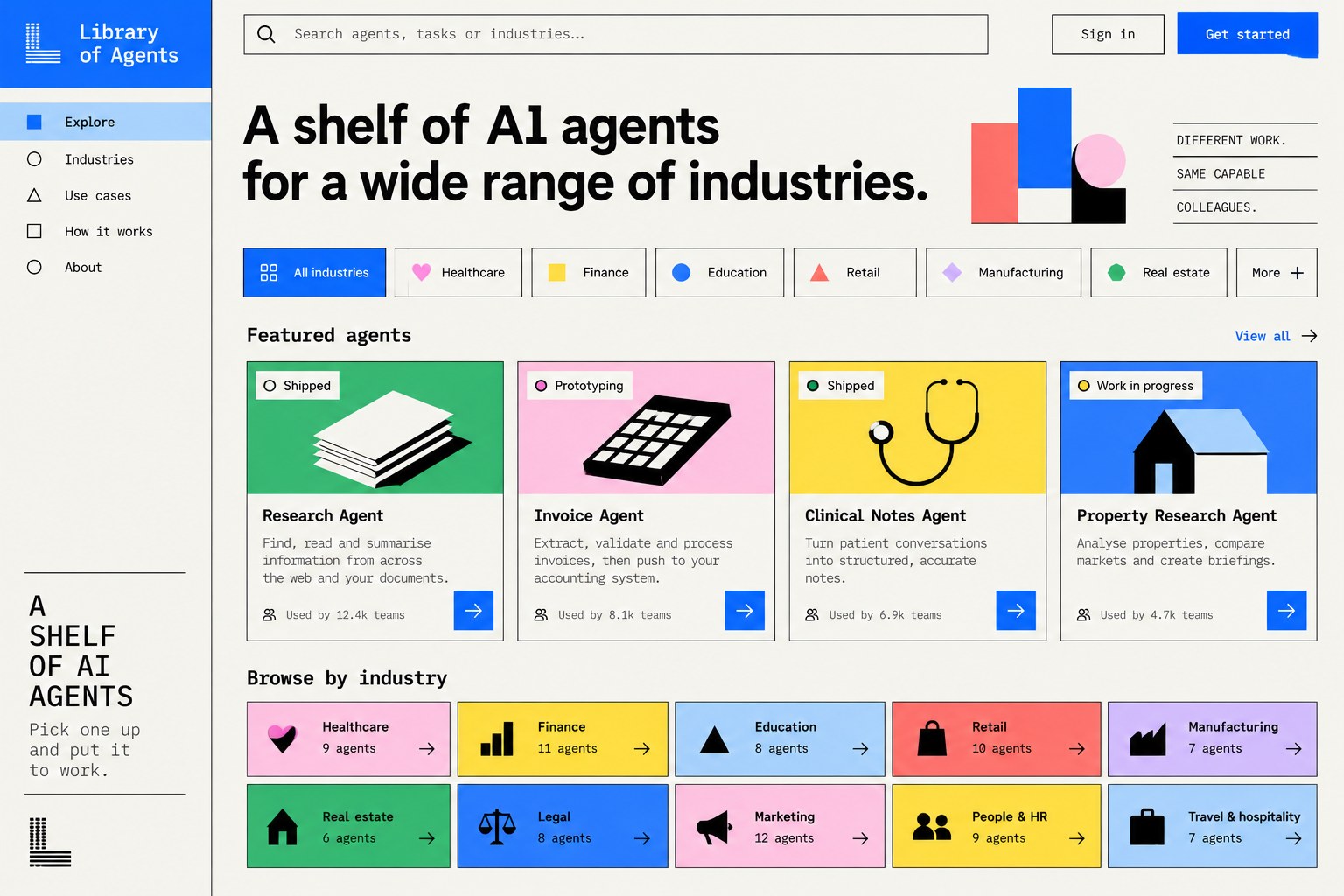
People often start AI work with a blank chat. Every time, they have to work out the role, the context, the inputs and what good looks like.
A library gives them a starting point. Pick an agent built for one specific job, see what it needs and what it can’t do, then put it to work.
It’s as much a service and governance problem as a prompt problem. Discovery, inputs, review, feedback and maintenance all shape the experience. A trustworthy library also helps you decide when not to use an agent.
Problem
A blank chat makes people reinvent the role, the context and the expected output every time. A library can make good starting points easy to find, while keeping the person in control.
Research
Planned: test agents on representative tasks with a rubric for relevance and completeness, including missing-context and adversarial cases.
Prototype
The flow: open an agent card, see its purpose and limits, add context in a short form, review the result, then copy or refine it. [Verify: what's built today]
In people’s hands
Next: put it in front of designers and knowledge workers with repeatable, bounded tasks.
What happened
My bet so far: narrow, transparent agents beat a big catalogue of overlapping ones. Broad agents with vague promises are hard to evaluate.
What’s next
Add clearer examples, version history, evaluation notes, and a way to flag a bad output.
How I’m approaching it
The Double Diamond, as planned. Plans loop back once real people get involved, so this one does too.
- Discover
Find the tasks people repeat often enough to deserve an agent.
- Define
Organise the catalogue around what people are trying to get done.
- Develop
Prototype the agent cards and one working agent.
- Deliver
Test output quality, and especially the failure cases.
- Define
Narrow the scope wherever agents start to overlap.
- Develop
Build an explicit model for evaluating and maintaining agents.
UX practices
- FindabilityAgents are organised by the job someone needs done, not by technical category.
- Expectation settingEach agent shows its purpose, inputs, example outputs, limits and when a human should review.
- Feedback and recoveryEasy to edit context, retry safely and flag a poor result.
Service design
- Service blueprintingThe browse-and-run interface connects to orchestration, model providers, logging and maintenance.
- AI governanceClear ownership, review criteria, versioning and escalation for harmful or low-quality output.